Every few months, another healthcare SaaS company announces they’re building the “operating system” for their vertical.
CRM. EHR. RCM. Patient engagement. Billing. Scheduling. Analytics. All in one platform.
And every time, the marketing positioning statement sounds the same: “The all-in-one platform for [specialty] healthcare.”
Beware. Beware. Beware.
“We do everything” isn’t a marketing positioning statement. It’s the absence of one. And it’s a trap that swallows B2B healthcare companies whole.
The Problem With “All-In-One” as a Marketing Positioning Statement
Here’s what happens when you build your marketing positioning statement around “all-in-one”:
You compete with specialists in every category simultaneously. Your EHR competes against EHR companies that have spent a decade on that problem. Your RCM competes against RCM companies backed by $200M in funding. Your patient engagement competes against companies whose entire engineering team works on nothing else.
And you’re “pretty good at all of it.”
Pretty good doesn’t win enterprise deals. Enterprise buyers don’t want the Swiss Army knife. They want the best scalpel they can find for the specific surgery they’re performing. (Think of it like an NBA roster. The player who’s “decent” at shooting, passing, defense, and rebounding but not great at any of them? That’s your seventh man off the bench. The specialist who does one thing at an elite level? That’s your All-Star.)
A marketing positioning statement built on “all-in-one” tells the buyer: “We’re adequate at many things.” It prevents you from ever being “the best at something that a defined set of customers cares a lot about.”
That second version is the one that closes deals. The first is the one that produces 18-month sales cycles and ghosted champions.
The “Everything Is Average” Death Spiral
Here’s how it plays out in practice.
Your engineering team ships features across 6 modules. Each module is fine. Functional. Decent UI. Checks the box.
But then the enterprise buyer pulls up your RCM module next to a company that has 80 engineers working on nothing but revenue cycle. Your scheduling next to a company whose entire product is scheduling. Your analytics next to a dedicated analytics platform.
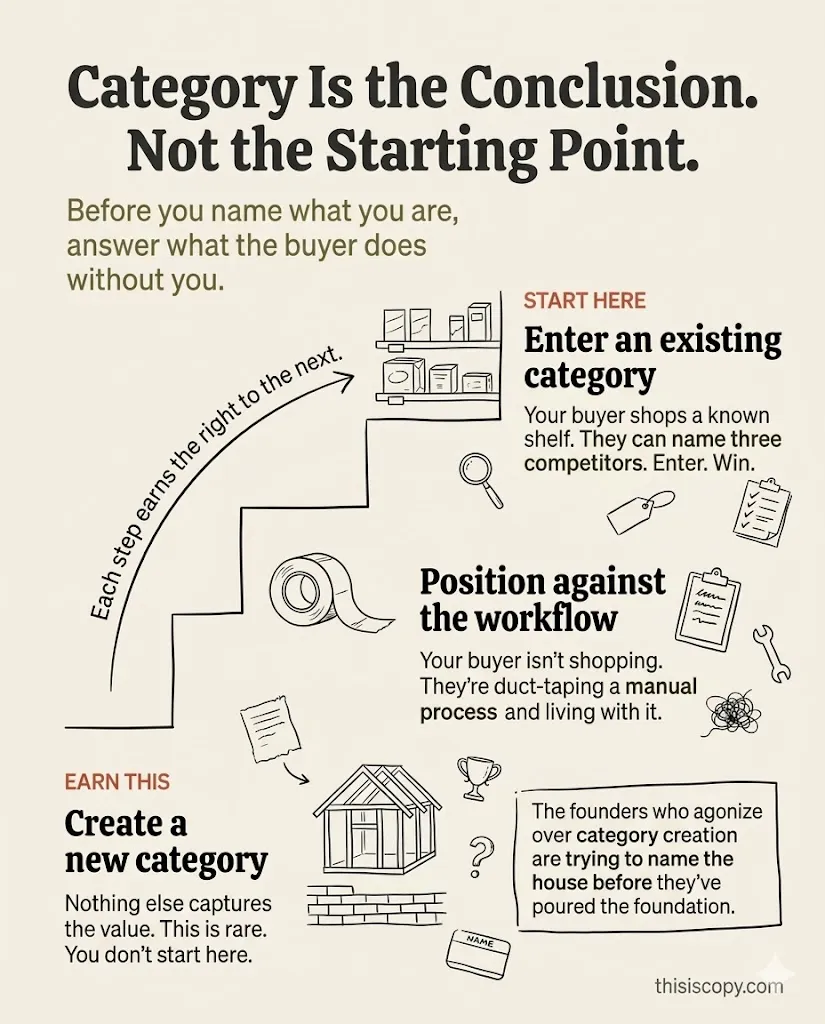
Module by module, you lose every comparison. And the integrated value (everything talks to everything) doesn’t survive when three of the six modules get replaced by best-of-breed solutions the buyer already trusts.
That’s the unbundling problem. When your modules are “good but not great,” enterprise buyers keep their existing best-of-breed tools and your integrated value proposition collapses.
Your marketing positioning statement promised integration. But the buyer wanted excellence.
Companies That Got the Sequence Right
The companies that actually became platforms in healthcare didn’t start with a marketing positioning statement about being all-in-one. They started by winning somewhere specific.
Modernizing Medicine started with a visual, iPad-first EHR designed specifically for dermatologists. Not “healthcare providers.” Not “specialists.” Dermatologists. They nailed that vertical so completely that expansion into other specialties felt earned, not claimed.
Athenahealth began with billing. Just billing. athenaCollector solved cash flow problems for small practices. Then they layered in clinical documentation. Then patient engagement. Over years. The marketing positioning statement evolved as the product earned each new claim.
PointClickCare found skilled nursing facilities (the segment that Epic and Cerner ignored entirely) and built everything around that wedge. They didn’t compete with the giants. They served the customers the giants didn’t want.
The pattern is the same every time: win a specific fight first. Then expand from a position of strength. The marketing positioning statement should reflect where you’ve already won, not where you hope to be in three years. I broke down the full cost of wrong-shelf positioning in my Regard case study.
The Behavioral Health Exception (That Proves the Rule)
Some companies have made integrated platforms work in healthcare. Kipu, Sunwave, Jane.app. But look at how they position it.
Kipu doesn’t lead with “all-in-one.” They lead with understanding the addiction treatment patient journey (the fact that a patient in residential treatment has fundamentally different workflow needs than a patient in outpatient therapy). The integration is the feature. The positioning is the expertise.
Sunwave positions around the problem, not the product: disconnected systems are the primary source of treatment provider failure. The marketing positioning statement isn’t “we do everything.” It’s “the disconnection between your systems is destroying patient outcomes.”
Jane.app focused on the messy workflows of independent clinics. Not “healthcare.” Independent clinics. The specificity of the audience made the all-in-one claim credible because the scope was narrow enough to actually deliver on it.
In every case, the marketing positioning statement leads with depth, not breadth.
Four Ways “All-In-One” Destroys Your Pipeline
1. Integration Entropy
Even “all-in-one” platforms need external connections. Labs. Pharmacies. Registries. Clearinghouses. The specialized players have spent decades building these integrations. Your platform is six months old.
2. Sales Cycle Death Valley
When your marketing positioning statement promises everything, the evaluation includes everything. That turns a 3-month sales cycle into a 12 to 24-month enterprise evaluation. And your Series B runway doesn’t survive that.
3. The Billing Code Problem
AI-generated clinical notes that don’t produce the specific narratives insurance adjusters need create denials at scale. Billing isn’t a feature you bolt on. It’s a discipline that companies spend years getting right.
4. Brand-Category Whiplash
“Simple” branding appeals to clinicians. “Operating system” positioning appeals to executives. Your marketing positioning statement can’t serve both simultaneously. (It’s a bit like the premise of Severance. You can’t literally be two different things to two different audiences and expect anyone to feel like they’re getting the real version.) The C-suite cares about margin expansion, labor displacement, revenue integrity. Clinicians care about fewer clicks and faster charting. One marketing positioning statement can’t hold both audiences.
What to Do Instead
If you’re building an integrated platform in healthcare (and there are good reasons to), the fix isn’t abandoning the vision. It’s fixing the sequence.
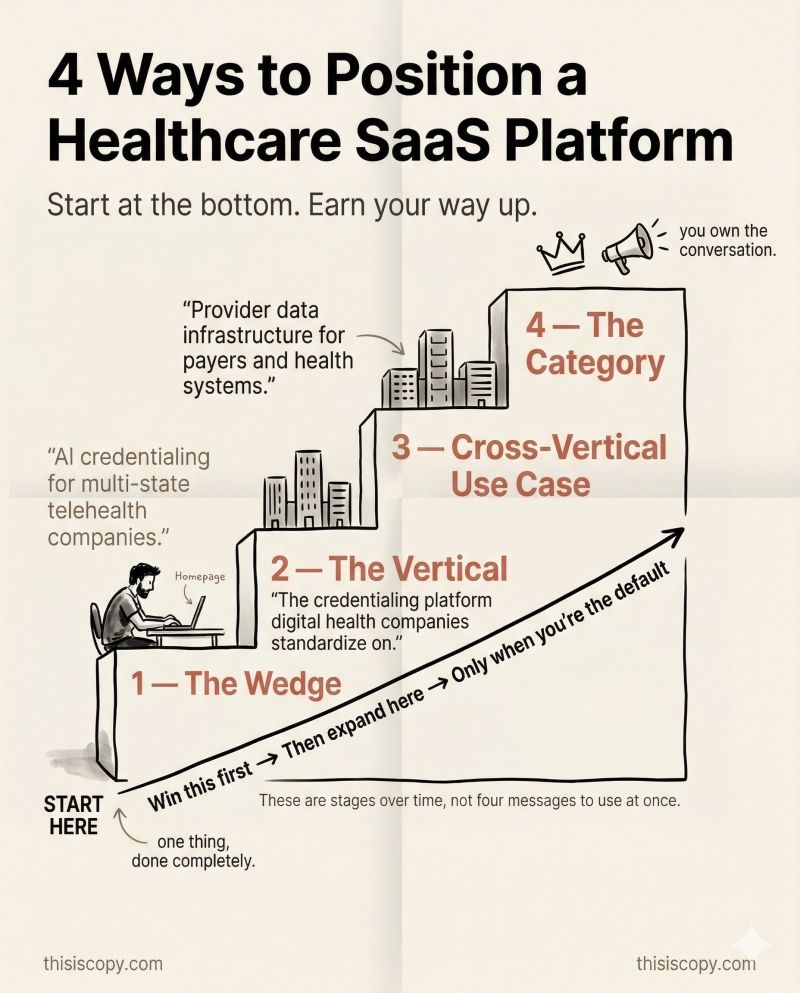
Step 1: Pick your strongest module. The one where you have the deepest differentiation. The one where customers say “this is the best I’ve ever used.” Lead with that.
Step 2: Write your marketing positioning statement around that module. Not the platform. Not the vision. The thing you’re actually best at today. “The best [specific thing] for [specific buyer].”
Step 3: Earn the expansion. Once you own that wedge, customers will ask “do you also do X?” That pull is infinitely more powerful than pushing “we do everything” from Day 1.
Step 4: Let the marketing positioning statement evolve. Athenahealth’s positioning in 2004 was about billing. Their positioning in 2014 was about the connected healthcare ecosystem. That evolution was earned over a decade of proving each claim before making the next one.
The all-in-one vision is compelling. But vision doesn’t close deals. Positioning does. And a marketing positioning statement that tries to claim everything ends up owning nothing.
See how positioning becomes the actual words on a homepage. Read the case studies.